

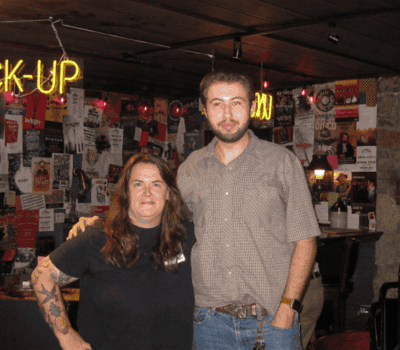
On October 3, I had the pleasure of attending the John Moreland and Mariel Buckley concert at Felton Music Hall, one of the various stops on their tour. Before the show, I got to sit down with Mariel Buckley for an interview, which revealed a look behind the curtain to her creative process, inspirations, upcoming projects, and stories that shape her music.
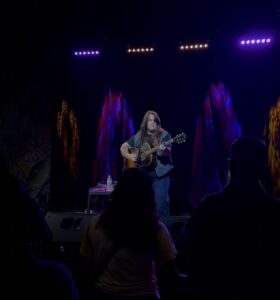
Mariel opened the show and set the mood with her blend of moody rock and country, even performing some tracks from her upcoming album. The new material showed a lean towards electric rock, which has always been an element in her songs, while still holding onto her folk roots. Her presence on stage was marked by a sense of humor that helped ground the performance and draw in the crowd.
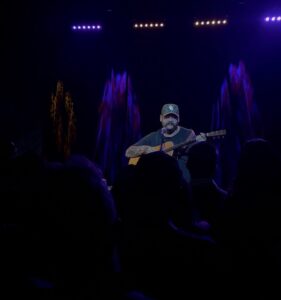
John Moreland followed with his signature mix of blue. His thoughtful lyrics were chased back by the crowd, bringing a sense of unity. His sound was warm and authentic, his songs felt honest, which left them lingering after they’d been played. The inclusion of a harmonica for a few of his songs helped elevate the raw storytelling that’s prevalent in his songs.
Mariel Buckley Interview
By: Jacob Gonzalez
[00:00:00] J: All right, I’m here with Mariel Buckley. It’s a pleasure to have you! How are you? How’s Santa Cruz treating you?MB: Oh, it’s beautiful—gorgeous this time of year. Perfect weather.
J: Awesome. The fall is my favorite time around here too.
J: Jumping right in—I see that you have a new LP releasing on the 17th.
MB: That’s right.
J: Did this one feel a little different than your previous albums?
MB: Yeah, this one definitely has more of an alt-rock energy. There’s still some country and Americana in there, but it leans more into that ’90s alt-rock sound.
[00:01:00] J: Awesome! Do you have a favorite track from the new record?MB: That’s tough, but I’d say the last song. It’s my favorite for the songwriting and it wraps up the record perfectly.
J: I’ll have to check that one out for sure. There’s a real sense of honesty in some of your songs—especially Everywhere I Used to Be. It felt very confessional. Are there any stories attached to your songs you’d care to share?
MB: Most of my songs have elements of truth. For example, Hate This Town was inspired by my experiences growing up. I had a tough time in church when I was young—some people weren’t welcoming to everyone. That song comes from feeling like an outsider. Many of my songs draw from growing up in a conservative environment, but each one contains a real story from my life.
[00:02:00] J: Now that you’ve traveled more, has that perspective changed?MB: Definitely. Touring and meeting new people around the world has really opened my mind.
J: Your brother’s also a musician. I have a sister in a similar situation, so I’m curious—what influenced you both to pursue the same career?
MB: Tim’s seven years older than me, so he really paved the way. He’d been playing guitar since I was small, and he and my dad got me my first guitar. His support was huge—he’s a great songwriter and guitarist, and a big reason I’m doing this.
MB: Funny story—he didn’t even know I was writing songs! When I was about 22, I came out of my room and said, “I think I have enough songs for an album.” He was shocked—he thought I was just hanging out in there, not writing. Once he found out, he was super supportive.
J: You both have your own distinct sounds, but there’s still a connection. How did your styles diverge over time?
MB: Early on we sounded alike—same influences like Neil Young—but he went more toward Guy Clark, Jerry Jeff Walker, and Townes Van Zandt, while I leaned toward modern Americana like Ruston Kelly. So, similar roots, different directions.
MB: Totally. Singing together is always fun.
J: I heard your cover together—it was awesome.
MB: Thanks!
J: You’ve toured across Canada, the U.S., and Europe. Do you tailor your setlists to each venue?
MB: Usually, yes. I keep a core setlist for each tour but adjust it depending on how audiences respond. For this tour, I have about ten songs I rotate through depending on the vibe of the crowd and the venue.
[00:05:00] J: Speaking of touring, any favorite memories from this run?MB: It’s been a great one. We stayed at the Madonna Inn in San Luis Obispo—it’s this wild ’70s spot with an all-pink dining room. It was silly but really fun. I also loved Albuquerque and Santa Fe—New Mexico’s beautiful and full of history.
J: Glad you’re finding time to enjoy it! You were featured at AmericanaFest this year—how was that?
MB: It was great, though I had to cancel my set due to a vocal issue. I’ve played it before, though, and it’s one of the best events you can do. The people who run it are amazing.
[00:06:00] J: That’s huge—congrats! Next year you’ll be joining Matt Anderson again for The Hammer and The Rose tour. How did that come about?MB: The last time I played in Felton was with Matt. His team has been supportive for a while, and when he reached out, I jumped on it. The tour goes across Canada’s most iconic venues—Massey Hall, and others from one to three thousand seats. I’m really excited.
J: What are you most looking forward to about it?
MB: Honestly, I love support tours. You get to learn so much from another artist over time. I always leave those tours inspired.
[00:07:00] J: Who are some of your biggest influences?MB: I love Lucinda Williams, Gordon Lightfoot, and Kathleen Edwards—she’s an incredible Canadian songwriter. Ruston Kelly, Mark Kozelek from Sun Kil Moon—there are so many great writers. If it’s a good song, I’m inspired by it.
J: How did the opportunity for this current tour come about?
MB: Funny enough, John Moreland’s wife is from my province in Canada. We’d been online friends for a while. I sent them my record, said I’d be in Nashville, and they reached out about opening. It worked out perfectly.
[00:08:00] J: That’s so cool—it almost never happens like that.MB: I know! It’s rare, but I’m really grateful.
J: Final question—what do you hope someone walking out of your set tonight takes away?
MB: I just hope they feel understood and seen—whether for themselves or someone else. That’s the whole purpose of music, to bring people closer together.
J: That’s awesome. I’m really looking forward to hearing the new album when it drops. Good luck tonight, and thanks so much for talking with me.
MB: Thanks for having me!
J: Of course—anytime.