

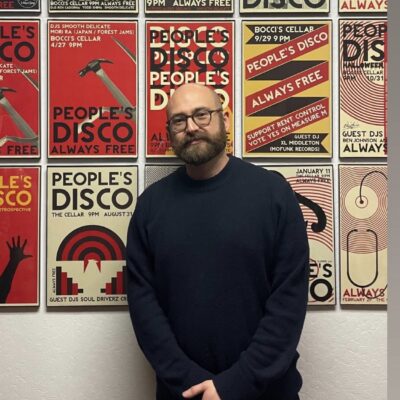
Interview by Annelise Schouten & Serafina Holzer
“As a non-commercial, educational radio station, KZSC supports the free expression of ideas. Please be aware that the opinions expressed are those of the speakers or artists only and do not necessarily reflect the views of the UC Regents, KZSC staff, management, or underwriters. We welcome your feedback on our programming. Please direct your comments to the New Media Director by email at [email protected].”
On February 27th 2026, Serafina Holzer, KZSC’s Rock Director and I (Annelise Schouten, KZSC’s Jazz & Blues Director) sat down for an interview with co-founder of People’s Disco, Jared Gampel. Taking place in KZSC’s studio B, Gampel brought with him a stack of rare disco tracks, playing them throughout the conversation about the party’s ethos, music history, and People’s Disco’s 10 year anniversary. Peoples Disco’s first party of 2026 will be happening this Saturday March 7th, with guest DJ Abby Imperial at Moe’s Alley, marking their 10 years.
A needle drop of the track “Put Our Heads Together” by the O’Jays from Jared’s personal collection began our interview, the following text is that conversation.
This interview has been edited for clarity and concision
A: For those who don’t know. Who are you? And what is People’s Disco?
J: My name is Jared Gample, and I’m one of the co-founders of People’s Disco, which we describe as a revolutionary socialist dance party that we’ve been throwing since February 26th of 2016. So yesterday, informally, was our ten year anniversary. We’re very proud of that. And for us, you know, I don’t have our mission statement on hand, but you could say that the party serves a couple of functions. One is that it’s just a place for people to dance that feels like a good time, kind of a community space. It started because there were no places in town that we wanted to dance at that were playing music that we liked. So, Janina, the other co-founder, kind of nudged me to do something, and we ended up just doing it together. Another thing that the party kind of became was about space for the left in particular. A lot of people who are my generation, I’m 37, so millennial, we didn’t get a lot of left culture and institutions passed down to us. We kind of understood ourselves living in the long shadow of defeat, and we thought it was incumbent upon us to start those things.
Now, we didn’t think it would be a long thing when we started, we thought it was just going to be a one off party, but that’s what it became. And so when that became more clear, the vision of the party kind of crystallized and we said, this is a place for the left to get together, find each other, and to remind us that there are people that share our values and our commitments. Because organizing can often be a more conflictual space. So if you get people who are debating about strategy in one context, dancing in the same room together, you kind of remind each other why you’re in the fight together, even when you disagree. And that’s kind of what it means to be comrades. Beyond that, we also realize it’s got a propaganda function, and we don’t really use that term the way that a lot of people do, as a negative term, like it’s brainwashing or manipulation. We mean it in a kind of neutral way as spreading a message. And for us, in a town that has become increasingly unaffordable, putting up socialist propaganda around town is, at least at the cultural or symbolic level, a way to say there are contending systems of values in this town, even if that’s not represented, say on our city council. That there’s a reason to fight back against developers and the way that the university is reorganizing, the way the city feels. And so in all these ways, the party has kind of taken on larger significance than when we started it. But that’s kind of how we think about it.

A: Being built on these socialist, and revolutionary socialist values, how do you think that’s reflected through the music that you pick and the DJs that you invite to spin?
J: There’s a lot of ways that I think that kind of comes out, but not exclusively. I think musically, popular music is complex. So I teach a class here on American popular music history. We listen to a lot of stuff, and students will after we listen to it, kind of decode it. And that often leads to differing interpretations about the same song. So a song that someone might read as a kind of conservative song, someone else might see it as progressive or liberatory in some way. And many songs contain both of these moments right? Like, you can think of a lot of hip hop as kind of distilling that, contradictory politics.
That said, I think there are a lot of songs that we play that, in one way or another, are congruous with our message, not necessarily revolutionary socialist, but emphasize the importance of collectivity or organizing. That’s an important thing to us. The song that we started this interview with is a song called “Put Our Heads Together” by the O’Jays. And a lot of people know the O’Jays because they know “Back Stabbers” (1972 track) or something like that. And I heard “Back Stabbers” all the time sitting in the passenger seat of my dad’s car. I can still hear his voice saying, “the smile in your face”, you know. But as I got into funk, I realized that a lot of these groups that had hits in the early 70s that were more in the soul idiom, changed with the times. And the O’Jays was one of the bands that did that, because they’re really just singers, and they had different people backing them up. And the song “Put Our Heads Together” was released a little later in 83. At a time where boogie funk is happening and you’re getting those synths and drum machines and that big production sound. I got put onto that record early when I was getting into this style of music. But you know, a song called “Put Our Heads Together”, kind of speaks to the ethos of what we’re about. In the break it goes “That’s why we’ve got to organize” and because those are our commitments it’s like, okay, yeah, we’re going to play that.
That said, we play a lot of stuff that isn’t lyrically congruent with our values. And frankly, there’s a lot of music that I don’t know what it is saying. I play a lot of international funk and disco records and I only speak English. So it could be saying anything, but if it moves me, if it feels like a tune that’ll work on the dance floor, then I’ll then I’ll play it and that’s always what it’s going to be first. There’s a lot of songs that are politically on point, but feel really didactic in a way that is not exactly fun. And for us, it’s really the music first.
A: And speaking about your ethos and putting the music first, how does playing physical media play into that?
J: That’s a great question. First, the reason we play physical media, exclusively, you know, is that we kind of came out of a funk revival moment, and there’s a chapter of my dissertation that’s all about this. So basically, 80s funk was not something taken very seriously by record collectors until the early 2000. People were really into these rare 45s, 70s breakbeat stuff, things inspired by James Brown, but maybe like a little bit of a later era. Not that 60s stuff, but, you know, 70s. I mean, Brown kept making music in that period, and he was sampled a lot in that period, “Pay Back” all that, but people were looking for rarer stuff, and that’s what record collectors were into.
But in the early 2000, a guy named Dām-FunK down in LA, grew up in Pasadena, started a party that kind of started to build a culture around this moment of music. And he was a big fan of Prince and things, when synthesizers and drum machines were getting introduced into funk. I’d say with varying degrees of success, but I got really into that style as a result of the culture that was built up around his party. And then other parties launched, one in Santa Ana called Funk Freaks, another in San Francisco called Sweater Funk. And a little network formed around this 80s funk moment.
Now, I was always a record collector. I mean, my whole life, since I was probably 15 or 16, I bought my first record, and it’s because I grew up in a middle class suburb and got into punk rock. Punk rock is also a musical culture that emphasizes physical media and there’s a kind of trajectory that bands were on. You know, you put out your demo on a cassette or at that time maybe like a CD-R and then you would put out your first real recording on a seven inch and then you would put out an LP. But there was always an emphasis on that. There are always distros (DIY distributors of vinyl, tapes, and zines) at punk shows. And so I got into collecting early and I just caught that bug.
So long before I got into dance music, I was a record collector, and I really didn’t get into dance music probably till I was around 23 or 24. But, I was already into records. So when I expanded my tastes and started going to these parties and then eventually started throwing one, I was coming up in a scene that only played records, and so I fit in naturally, like I didn’t even think about digital music. I just did not. It does have certain benefits for us. I’ll say that often the people that ask us to play, ask us prematurely, like they haven’t spent enough time at the party to really know what we’re about. Maybe they just started DJing and they’ll play on a controller or something like that. And they’d say, “I’d love to play your party” and I ask, “oh, what kind of records do you collect?” Like, what kind of music? and they respond with “Oh, I don’t collect records”. I’m like, oh, you probably haven’t really been that much, you know? And that’s one way of kind of, not hurting anybody’s feelings and saying if you get into this world maybe you’ll play one day.
I don’t see it as gatekeeping or something like that because anyone is welcome to participate. And actually it’s one of the most inclusive cultures I’ve ever been a part of. Far more than punk actually. But, it does really organize the scene around people who kind of obsess about music. You don’t have to obsess about music to be a record collector, but I know a lot of record collectors who are obsessive and I don’t know many people who are obsessive about music and have no physical media library of their own.
A: Going back to that story of how you got into dance music, what’s the story behind that?
J: The story is that I used to live in Toronto, and I did my masters at a school called York, which, if you are a Marxist and you’re interested in political economy, it is, or at least it was, the preeminent place to study in that tradition. It still is fantastic. But a lot of the people who were there when I was there have either moved on to other schools or have passed away. And my interest in that is also what brought me to UCSC. But when I lived in Toronto, I had a roommate who became my best friend very quickly, and he was a queer guy, and he took me to places I wouldn’t otherwise go. And, there were a couple nights in particular that I went to. One was in a warehouse where it was extremely hot, but there were fans, the music was incredible. Really, really deep disco stuff. And I was just kind of blissed out. I had probably a handful of beers and, you know, at a certain point, it was just so hot and people were walking around, feeding each other frozen watermelon. And I was just like, okay, yeah, I’m in for that. And I just, I just had an incredible time. And at a certain point I was like, wow, I didn’t know this music could connect with this stuff in this way.
And if you come from the background I did musically, like a punk rock background, especially the end of punk that I was into, which was like Grindcore and Powerviolence and Crust and, you know, like the end of punk that was not wearing basketball shorts, but kind of dressed in all black and had charged hair and all that kind of thing, you know, discharge bands. So if you come from that, dance music it was just not even something that really registered to you. You just didn’t really care. I learned later that a lot of post-punk that I loved was really influenced by disco. And, you know, it took a while for me to get there, but at the time I wasn’t really thinking like that. So I asked this DJ who was playing, “what are you playing?” And he showed me this compilation of rare disco called Under the Influence, and it was one of the early volumes of that. Funnily enough, ten years down the line, we end up having the DJ who put together, Under the Influence volume three at People’s Disco. So he played last year and that was fantastic.
Everything kind of came around full circle. But going to that party in that warehouse exposed me to, not just the music itself, which I don’t know if it would have ever connected me outside of the context in which I experienced it. But also like kind of a community that felt organized around this stuff. And I came back really, really excited, really excited. And that’s when I said to Janina, man, where can we go to dance to this kind of stuff? And that idea percolated for a few months and that’s how things went this direction. But that’s kind of how I got into this stuff. And I dove really, really head in and once I started discovering these records, going up to Sweater Funk, every Sunday night, you know, before I had class and on Monday, the next morning, people called it going to church because it was every Sunday, you know, I would discover all this music and all of it was new to me.
Some of it could have been a dollar bin record, you know something I didn’t know, a Luther Vandross track, that was all new to me at that time, but it would be played next to some incredibly rare thousand dollar Funk record that’s like a collector’s grail. And you kind of find out because all of a sudden this crew of people who are all ten years older than me at least, maybe 15, I’ll get on stage and they are looking over at the decks asking, “is that an original copy” or “is this a reissue?” or something like that. And that was my acculturation into record collecting this music and that scene.

A: What was it like to come to Santa Cruz where there isn’t much of that until People’s Disco came around? What was it like to start that project in the scene when it was started in 2016?
J: You know, now I feel like I’m connected more to people that play dance music and, well, I guess one thing to note is that I’ve been here a long time. I moved here in 2006 to do my undergraduate degree, so I’ve been here on and off, but mostly on for close to 20 years. September will be 20 years. You know, I did a little time away. I went back to LA where I grew up, after school for maybe a year, year and a half. Then I did my masters, as I mentioned, at the school in Toronto. And then I came back here for grad school again in 2013. So I’ve really been here for a long time. And when I was in undergrad, there was a lot of dance music stuff here. I didn’t care about it, but it was here. You know, there are a lot of reggae parties. A lot of that stuff was actually record centric. There’s a lot of house music. A lot of renegades were thrown, you know, things kind of in the forest, off the grid, all that kind of stuff. But I don’t really know the history that well, because that wasn’t for me. And that stuff still isn’t really where I locate myself musically. I think the way that we started was to be one more node in this modern funk network, this like revival culture network.
So I understood us as kind of doing something distinct here, but something that was absolutely indebted to those parties I mentioned earlier. And, it became clear pretty quickly that if DJs were touring, say, coming down south from Sacramento or San Francisco and they’re going to play L.A. or vice versa, someone from San Diego, LA, is coming up the West Coast to play Sweater Funk or something like that. We became a place they could also play. So that’s kind of how I understood us. It’s like part of something bigger that was happening culturally, even if locally we kind of stood out, though there were connections, we didn’t make this music important on the Central Coast. And when I talk to people who are older than me, and when I started doing research into this stuff, I learned a lot about how much this Funk music meant to Chicano communities throughout California.
So, there was a DJ, named Bubba G Scotch who played in a style called Old school. You know, it’s like a kind of radio format that mixes Boogie, Funk, Electro, and earlier Hip Hop all together to make it more of a coherent sound. And it’s only later on that that Boogie became this really niche thing. And that’s something that happens a lot. I think, with music, that collectors glom onto something and hear certain sounds as distinct from others that weren’t at the time and they make it its own kind of contemporary subgenre. And that’s one of the things that happens with Boogie, it becomes distinct from all these other styles that would have been played together in the 80s and the 90s on a format called Old School. So when I meet these older Chicano DJs who are telling me about Bubba G Scotch and how he was kind of a mentor to him, you know, I’d go to their house, I’d hang out in their garage, we’d play records together there. You know, my friend’s wife would bring out food, they’re both kind of family guys. Or at least that’s what happened one time I played, I have another friend who he and his wife are a DJ kind of team, and they play a lot in Oakland. And they play House, too. So they met in the House scene. But also we’re into this earlier period of music.
Anyway, all this to say that California has a long history of playing this music, and it’s become a matter of Chicano cultural heritage. And so, that’s really interesting to me because it’s black music and it’s an interesting point of cultural connection and association and identity. You know, for a lot of people and even people that didn’t grow up with the music.
A: Also talking about that kind of network of DJs, when it comes to the actual collection of records, where are you sourcing this material from and what networks exist within that world?
J: I buy records from everywhere, I’ll still look at the guy selling garbage on the street, you know like boxes and boxes of chud. But sometimes you find something great in there. So, for example, I found this really, really rare funk 45 by Ramsey 2C-3D on the Budweiser label in this guy’s bins. It’s probably a $500 45, and I was like well I’ll probably never own that. I wouldn’t pay for it, it’s like if I had 500 bucks to spend on a record that wouldn’t be the one. But I found it there. So I’ll dig through garbage to find stuff. But also I get a lot of stuff, at least new records, from Redwood Records. I’ve worked there for 12 years one day a week. I started three months into grad school and when I finished grad school and started teaching here, as a lecturer, I couldn’t give it up. And, I buy a lot of new stuff there. And I think there’s some good records coming out in the last couple of years. That gives me a reason to stay and push that stuff on other people and also get some stuff for me out of the deal. But I also go digging a lot.
I’ll also go up to Oakland, I’ll go to San Jose, I’ll go to San Francisco. I’ll hit a ton of shops. I know that you interviewed Chris from Groove Merchant, and for sure, if I’m in the city, I hit Groove Merchant and I’ll ask him like, “hey, you got any? You got any boogie funk stuff?” He goes, “oh yeah, yeah, check this one out and I’ll pull something behind the counter”. That’s one way to get put on. Definitely the more people you know, and the kinder you are to people, the more they’re going to be like, “well you know, I got this one behind the counter”.
And like everybody else, I buy online, though I think the online market is torture these days. It’s like every record I want there’s one copy available, and someone’s trying to sell it for ten times more than it has ever sold for, it’s just that that world is increasingly less fun. I should also mention that I buy a lot of African records, and I brought one today for us to listen to, and I still get those from all over to, you know, I buy records from dealers in Africa. There are different shops that specialize in that stuff who import it and I’ll kick a want list to those people and if something comes in, they’ll tell me, “hey, I’ve got I’ve got this. You want it?” and I’ll say, “yeah, of course”. Sometimes I’ll trade with them because a lot of these records are a lot of money, and I’ve never had a lot of money. I’ve always been broke, so I find ways to make it work. Like, there’s a guy, down in LA who was importing this stuff for years over the pandemic. And, he just wanted things he could sell easily, so if he had a $1,000 African disco record that wasn’t exactly flying off the shelf, no matter how much people wanted it, he’d say, “hey, Jared, I’ve got this record. Why don’t you trade me for it?” So I would send him a box of records and he would send me the one and that’s how we did it. And you know, almost everybody I know who’s a record collector has crazy records. That’s something one DJ that we’ve hosted said to me, in the past, like, everyone has crazy records and it’s funny because it’s true.
But the DJs we’ve hosted have very different class situations. We’ve had people who work for minimum wage, people that work at supermarkets. And we’ve also had people that at one time or another were in finance. And yet all of these people have crazy records, just some make greater sacrifices. I guess I fall in the second camp.
A: I remember in my experience being with Chris I would ask him for the track name of the record he was playing and he’d give the record to me for free. Any time I’d show interest in a piece of media he’d tell me the story behind it and let me keep it for my own collection. And with the other people coming into the store, I felt like wow this is such an amazing community and network that they’ve built here.
J: Yeah. Chris has really earned all the accolades and respect that he gets. And, you know, record stores and record collecting were not incorrectly caricatured as unwelcoming places. You watch High Fidelity or something like that, and someone’s like, “do you have this Duran Duran record” and someone’s like, “yeah, it’s over in rock, you idiot”, or something like that. And these places were also framed as hostile to women, also a lot of truth to that. When I hear stories about the past, I think things have really changed on that front, in really positive ways. And I think that’s true at the shop I work at, who, you know, really made efforts for many years. Both the current owners and the old owner, when I started there to try and make it feel like it was for everyone, and to treat people with that kind of approach and the same way that you described how Chris treated you. Because that’s how the culture grows to like, if you care about this thing I don’t see how pushing them out does that. Aside from it not being good for business, which I couldn’t care less about, but I do care about the cultural side. And I feel like you have to make the effort with people, if you want to make it feel the way you want it to.
A: Being at Redwood Records in comparison to, say, a record store on Haight Street like Groove Merchant, how is the process of collecting and selling in Santa Cruz?
J: One thing about Santa Cruz, I mean, it means that the records that come in the door are very different. Santa Cruz is a much, much whiter place than San Francisco. Especially historically, you know, Santa Cruz used to be like a sundown town and San Francisco had very, very robust black communities. And that’s reflected in the music. So Chris will get a lot of black music sold to the shop. That’s a real challenge for us, it happens, but it’s often because a Chicano DJ in Watsonville will bring over a box of funk records. But, you know, some of it is just a demographic matter. You know, we’re always trying to get stuff from everywhere, but we often have to work harder to do it because of the place we live in, because of its demographic and political history. Ultimately I think there’s also been a kind of surge of people getting into records.
A: I feel like even in the current moment of streaming, there’s a surge of people buying records and turntables, even if it’s a really cheap record player from somewhere like Urban Outfitters, people are drawn to that. How have you seen that culture change while working at Redwood Records?
J: That’s a great question. One thing I’ll mention is there’s a book called “Vinyl” by these two anthropologists, Bart Manson and Woodward, and they track a little bit of the vinyl revival. And it’s really in around 2006, 2007 that records start to grow again in terms of sales and, you know, that was kind of the peak MP3 moment. And, that was a solid period of growth, for almost 20 years, I think until 2023 or 2024. That growth was real, real steady. I haven’t kept up with the scholarship of the last two years on what is happening with the market now. But in that period, I’ve noticed a few shifts, one, working at Redwood you just kind of see who’s coming into the shop, and that’s changed a lot. When I started there, we sold a lot of classic rock, and that’s kind of what we were doing and that also reflected the old owner’s tastes. He was like a big Zappa guy, Beefheart guy, you know, kind of classic, record collector dork tastes. There were a lot of that in that period, in particular for those first five years.
A lot of old men came in, just wanting to kind of relive childhood memories, punishing me with their stories. But, there were also people like me, people that were record heads, you know, long time collectors. It wasn’t for everyone. But it increasingly became that way. Over time, I noticed more and more younger people coming in and more and more women coming in, and that was like a notable shift. And with that, there was another shift. And I should mention that we only sell vinyl and a little bit of cassettes. So it really is like a record store record store. One of the things we noticed was that at a certain point, new music on vinyl was starting to sell, and that really marked a cultural shift. For a long time it was just old music and reissues, but all of a sudden there’s new music on an old format. It is starting to become important again. And I would say that was around 2017, 18, something like that. I remember the old owner, Paul, saying, “I sold a lot of Khurangbin records”. Now I hate that band because I work a lot in coffee shops as an academic and there’s certain bands and records I never want to hear again for that reason. So I partially blame Paul for selling those things and making that so popular. Or maybe that reflected the popularity, I don’t know, either way new music on an old format was making its way into young people’s hands and that was the big shift. And I still think we’re in that moment. Bands are saying we need to put stuff on vinyl again. And that’s not just coming from musical subcultures. In other words, punk never left the vinyl format ever. Techno’s the same. You know, a lot of dance music never gave up on the format. So when some people talk about a vinyl revival, people in those subcultures would say “for you”.
But for us we might mix mediums, I’ll play one track on vinyl next to a digital track on a CD for example. But the difference in terms of the record store and I think trends more generally, is that vinyl became a genuinely popular medium again. And that means that new audiences, new consumers, new music listeners are returning to the format, and new bands feel a certain kind of obligation to release their music. They’re not just digital.
A: Do you think that starting People’s Disco around that time was in part why it was so successful, and why it still is?
J: One of the things that I think made it successful is that we were committed to keeping it free. You know, one of the things about Santa Cruz is that it is increasingly unaffordable. And my sweetheart Janina, who I throw the party with, she’s ten years older than me, and she’s lived here for a long time and she could give you a longer history about how the town has changed, but I can tell you over the 20 years I’ve been here, there’s been huge cultural shifts. I would say the consequences of that unaffordability epidemic that we are living through. So we made it a principle with the first party to say, this will be free.
And if it’s a socialist event, unless you’re trying to fundraise for a particular cause, you should really be committed to keeping it free. And so that’s what we did. The first party was at the Crepe Place, and we hit capacity that first night. So that came as a surprise to me, you know, I begged every friend I had to come and have one beer before they left. I just begged them and I thought that, well, if the symbolism on the poster doesn’t turn people off, well, certainly this music will. So on the first side of it, Bernie Sanders was just kind of like getting onto people’s radar. I became a Marxist as a result of the financial crisis in 2007, 2008, and I started reading more widely. I was taking economics classes here, and I wasn’t compelled by the answers about what caused the crisis. My economic professors didn’t seem particularly interested in power, they just had us kind of crunching numbers and making lines intersect. But then I met some people who read more widely who said, “you should read this stuff. You should take these classes”. I did, and then I kind of, was won over to that. That frame for thinking about economics and about power. So, for many, many years, I was kind of on my own island there. Most of my friends were not Marxists, but I knew a couple that really changed as a result of Bernie Sanders saying “I am a democratic socialist”. And all of a sudden socialism was put on to a national stage, the 99%, 1% and so on, that socialism appeared like an alternative to that kind of inequality and Bernie Sanders became its leading representative in the US. As a result of that run for the presidency, socialism was no longer a dirty word. It was a contested word. And so we wanted to, at least at that level, try and intervene and as a result people associate socialism with fun, free public dance parties where everyone is welcome and not like gulags and bread lines, which is, you know, the American imagination of the Soviet experience.
On the musical side, I’ve had friends who were DJs long before I was one. And, a common thing that DJs will say is that no one will dance to music they don’t know. Always being a kind of subculture guy, I said, “well, I don’t care, I’m going to tell them what they need to hear”. I wasn’t having an oppositional posture in that way, it was just I inherited that. And it’s just part of my personality, and maybe that’s also being a teacher. Like, I want to teach you something, I’m going to show you what you need to know that you don’t know. In the same way that people treated me when they said, “you need to read Marx”, and they were right. So I kind of had that approach, not only to the courses I teach, but also to the music I play and perform. And I was shocked to find out that people were dancing to all of these tunes they did not know, and they loved it. And people asked when they didn’t know, “what is this tune I have to know?”
Over the years, we really built up a lot of trust with our dancers. We might get one request a night or none, but it will always come from someone who’s kind of new to the party, hasn’t quite been acculturated to what we’re about. And rather than be hostile to them, I’ll say, “this DJ here came a long way to play this stuff for you, and you wouldn’t be able to hear it, from anyone else, and you wouldn’t be able to hear it on this format. Like, I know this stuff is new to you, but try to be open minded. I can’t tell you how special it is that this person is here to play”, and every single time someone responds to me and goes, “thank you”. They weren’t expected to be treated like that. And for me, that’s a kind of teaching moment. I think it builds up trust between that dancer who was maybe there for the first time and this scene that they’re stepping into, and I think that’s been a really positive thing for us.
So another record I brought today, is a record by my friend Sudi. It’s a record he put out last year. He plays under the name Space Ghost, and he released this record with Teddy Bryant, Sudi played at Peoples Disco in November. And there was somebody who snapped a photo of him on stage handing a record to someone in the crowd who asked him what it was because she was like, I just have to know.

And that’s actually something that Dām-FunK started to do, with these early parties. So at his party, Funk Mafia in LA, he would take the mic and announce what the track was before Shazam and things like that. But we try to play things that you can’t Shazam too, but that’s another matter. And he would announce these tracks and nobody was doing that because DJ culture used to be very secretive prior to the popularization of the MP3. You would book this person because they’ve got this and no one else has it, and maybe they scratched off the label so no one can find out what it is. It was very secretive. It was very protective and very competitive. There were economic and cultural reasons for that, that I think for the better we’ve overcome. So Dām started this kind of culture of sharing music in a really direct way, and that became a feature of the modern funk scene. And that kind of carries on into what we do. I was really happy that that photo exists where he’s just handing some dancer a record because she just had to know, so I thought we could play one of his songs.
A: Yeah let’s play it!
Track played – “Some Things Last Forever” by Space Ghost & Teddy Bryant off their album Majestic Fantasies
S: Hey, it’s DJ Key. I know we’ve talked about why dance music and funk brings people together, but more specifically, why do you think the dance floor is a space for social equity and resistance?
J: I’ll say a few things about that. Because, I think a different view than a lot of people who play dance music of one type or another. One thing I’ll say is that with disco, the dance floor, you have to know the political history to understand why it took on that kind of political significance. With disco, that history has something to do with the fact that prior to the late 60s, it was illegal for men to dance with other men in the United States. And there were local laws around this. In New York, many of the bars were run by the Mafia, and they would have relationships with the police where the police would tell them, “hey, a raid is going to happen.” The Mafia would pay them for that knowledge and they would make sure that men weren’t violating these laws in their bars. So the gay bars were run by the Mafia. And that was the relationship. And this was a really degrading thing, for people, you know, bar managers would stand on ladders with flashlights and shine them on men that were dancing too close. It was a repressive environment. And so making the dance floor and associating the dance floor as a space of potential freedom is quite literal in that time because men didn’t have the right to be together in that way.
That’s the origin point but then the start of Stonewall changes this, and at this time, people at the bar start heaving bottles at cops. The kind of small-scale riots that last for a couple of nights. And the sense that resistance was possible changes things dramatically, like what’s going on, culturally. This was already after a process of minimal repeals of these laws were already underway in certain places. And so in that sense, yeah, quite literally, the dance floor had political dimensions.
Now, as time goes by, I think a lot of dance music, particularly a lot of House stuff, ‘peace’ and ‘love’ and ‘unity’ and all this stuff just become kind of buzzwords. And at some point, especially over the last 15 years, people really start to market their parties with social justice language. That was often offputting for me. Your generation would say it’s performative. For me, I think about it a little differently than that, which is to say I am a communist first and a DJ second. For me, that means that I am an organizer first. I don’t see the dance floor as the place where politics are happening. I see it happening in my union meeting, and I see it happening in my meetings at the DSA.
So I’m a member of the Democratic Socialists of America, it’s the largest socialist organization in the country. We have 100,000 members. Our most famous member right now is Zohran Mamdani; people are pretty excited about him. And so for me, that’s where politics happens. And I’m very frustrated with people that don’t do any organizing, and talk about their events like they’re doing some radical political thing. I’m just like you’re throwing parties, you know, at best you’re doing fundraising. But fundraising is also not where the politics happens, money does not build power for socialism. Now, you need to raise funds for certain things or whatever. And DSA is a member funded organization, so our unions don’t get money from big outside donors. And that’s why they have the potential to be more democratic than any institution. That’s taking big money donations for its survival, say, non-profits or something like that. But for Janine and I, we spend hours every week in meetings and they’re boring and they’re tough. As I said earlier, potentially conflictual and so we really emphasize that this is an event put on by socialists, and we want socialists to feel like they have some kind of cultural space in town.
But that’s not where the politics is happening. Politics is happening elsewhere. We’ve had people table and things like that every once in a while, but it’s only something that we are personally involved with. Like when we worked on a campaign for rent control we had other people who are part of that campaign there. And when my union was on strike, when I was a graduate student, we had a lot of leaflets and we were raising strike funds because we needed that money for food for the picket line. That’s a way that we can put the party in service of politics, and that’s a really different way than saying “wow, the dance floor is such a radical and inclusive space. It’s changing the world.” That’s hippie nonsense. That’s a way to excuse oneself from actually organizing.
If you are not a part of a political organization and some class based organization, all right. For socialists, the two axes of power are typically class power and then, something that resembles a party. So you do work in your union or you try to form one at your workplace/in your building, and you’re a tenant organizer. You’re trying to build leverage there for tenants against their landlords in the same way that workers do against their bosses. Then you use your socialist organization to coordinate those class based efforts.
If you are not doing those things and you want to say “no, but I’m doing this radical work on the dance floor” I’m just like, you are nuts or stupid, that’s one side of me. That’s my inner monologue I’m saying out loud. What I would actually do is to say to someone who is doing that, “let’s have a conversation about politics and power and let’s think about if you care about those things” which some people do and some people don’t. “Let’s talk about what you can do. Where do you live? What’s going on? What are your goals? Who’s already who’s already doing that work and how can you participate?”
A: I remember you talking about Moe’s Alley, where it’s located, and the importance of the location. As well as the function of the poster imagery. So if you could speak on that.
J: So we throw our parties at Moe’s Alley, after we moved from the Crepe Place because we outgrew it very quickly to a place called Bocce Cellar, which was great, but closed over the pandemic. And that was bigger than most. But, once they were done, we moved to Moe’s, and we’re very happy there. And Moe’s is off the beaten path, you don’t really end up at Moe’s unless you are going to something, a show there that you bought tickets for or something like that. And that’s really different from throwing a party downtown.
So Janina used to dance a lot at the Blue Lagoon, which used to be a gay bar. And a lot of younger people don’t know that. And it felt a lot different than it does now. I’m not trying to say the Blue Lagoon is unsafe or something like that, but, you know, you get a lot of people in there who are too drunk or are coming in drunk and it can be kind of a rougher scene, and you have to be careful, you got to watch your drink. You got to make sure you’re with your friends, that kind of thing. And, you know, if you throw public events, there’s no such thing as a safe space. This was something that also bothered me about the way that certain people talked about their events, because inevitably someone would describe their party as a safe space. But that was wishful thinking because they threw a public event and something would happen, and then they would have to think about how to navigate that and seeing that happen meant that we had to take steps to think about how we’re going to make this place, as safe and welcoming as possible. And there’s a cultural dimension to that, too, while still saying anyone can go to this and anything could happen.
But there are a few experiences that Janina had thinking about this, and that I saw happen at the party that communicated we were doing the right thing. So having a party away from downtown, a place where people aren’t just wandering in, that was one kind of safety measure you could say. It also meant that people who were there, wanted to be there. Not that they’re just like, whatever I’m doing the bar crawl, this is one more thing that’s open. One thing that we did is we would talk to our bartenders and our security, before the show, before we moved to Moe’s. And one of the reasons we ended up in Moe’s is because when we described this to their owners and staff, they said, “these are practices we’ve already adopted”. And that made us feel like, oh, we’re in a good place. So we would say to bartenders, never serve anyone that seems like they’re too drunk, and if someone seems too drunk, I want you to call them a cab and we’re going to pay for it. And that was something that we adopted early on. You know, it’s not uncommon for people to drink too much. You know, maybe you didn’t eat enough that day or whatever, you know, and it happens to everybody at some point. And you want to make sure that that person isn’t taken advantage of in any way and doesn’t get their wallet stolen or worse, so you want to make sure that they’re taken care of. And that’s one thing that we did. And Moe’s already did that, so we thought, okay, great.
In terms of the imagery, you know, we also thought, okay, this is a place for the left, but at the same time, it’s a public event. And we know most people that are going are not socialists. They’re not, maybe they liked Bernie or something for a time, but they’re not a socialist. They certainly aren’t going to the meetings. They’re not members of an organization. With the exception of maybe like a lot of UAW graduate student workers who are, and that was very much our first kind of like group of people supporting us was like my fellow organizers in UAW.
But, you know, sometimes people come with a whole bunch of ideas, even though it’s a socialist event. I remember one kid came maybe like two years ago, and he had an Obama shirt on, and I told him, “you can’t wear that here”. And he was just kind of like, “what?” And I was like, this is a socialist event, and this is our enemy. We don’t like this. It’s not funny. We’re against imperialism out here, you know, guidance. This guy dropped a lot of bombs. So, you know, turn it inside out, and I was a little more playful than that. But I was also just trying to say like, hey this is a different kind of thing. I don’t know what Obama stands for in this kid’s mind. And for most people, most Americans, especially now, Obama doesn’t stand for those bombs he dropped. He symbolizes when the U.S. still had some decorum or something like that.
Not for my generation. For my generation he’s the bomb dropper, and I’m curious to know what you guys think about past Democratic Party administrations, but for us, like, he was the deporter in chief, that’s what he became known as. And it was important to us, always to be like, that’s not what we’re about, or we’re doing something else over here. So, you know, the symbolism keeps some people out. Socialism, whether they think that’s the same thing as saying authoritarianism or they just don’t like the idea of a world without landlords or something, maybe that bothers them, then it’s not the place for them. But again, it’s a public event and you can’t screen everybody for their values and beliefs before they walk through that door. I’d like to think, too, that there’s a possibility that no one’s going to be won over to socialism through what we do, but it can open up a little bit of space for thought that might be meaningful down the line.
So maybe they came to this party, they had a good time. They’re like, okay, I don’t really like socialism, and think “that’s kind of funny”. Or maybe they thought it was like a theme party inside or something like that, which it’s very much not. And then maybe a year later, they take a class on Marx, maybe with me even, and they say, oh, I understand more about what this is.
And maybe this is like a more fun and interesting or ambitious project than I realized. And I do think that happens. I think that one thing that happens, too, is that people aren’t won over in that moment, but in their political development here in Santa Cruz, it might anticipate some things that they come to believe or care about.
A: Could you tell me a little bit about the event that’s coming up on March 7th.
J: Yeah. March 7th, we have a party at Moe’s Alley. It always starts at nine and ends at one. Doors open at eight. The line is typically quite long, so the earlier you get there, the better. And the guest is Abby Imperial. She’s a DJ based in the Bay area who plays a lot of New Jack Swing kind of stuff, but it is broader than that. And so we kind of come out of this modern funk culture I talked about, but that disco and boogie are the things we pivot around. You know, if people play some New Jack or some street soul, the occasional house cut here or there, we’re with it. We’re not super doctrinaire, but we only bring DJs we trust that come from the culture that we’re in or one that’s so adjacent that we play the same places. So I see Abby around when I go see a DJ at Bar Part Time. And we sold together recently, at the same record swap put on by one of the resident DJs at Bar Part Time. And so there’s a social world that’s part of it.

That was a tangent, but the party is on March 7th at Moe’s. It is free. Every poster says it is always free. It will always be free. And it is our first event of the year. At some point later down the year, we’re going to have a big ten year anniversary. But, this is just kind of doing it as we always do. Also, we have some key dates that we always kind of lock in around over the year. So, March 8th is International Women’s Day, it’s a socialist holiday, we always build a party around that date. We also have a party on May 1st, which is International Workers Day. I think Daniel T is going to play that party. Anyway, we’re excited for the upcoming stuff. And I’m really excited to play with both of these DJs. And also it’ll be both of their first times playing, playing our party. So, being someone who performs at every event, like, as the resident and a promoter, it’s always exciting to hear what DJs who haven’t played before have to say. So we have a little ritual where the the morning after the event we take the guest DJ out to breakfast and we get to kind of chat, get to know them a little better, and also talk about how the night went for them.
And, you know, it’s also one thing that makes you build personal connections and the culture feels like it has a life to it when you do stuff rather than just treating it as a gig or something like that. Throwing free parties obviously is not something you do for the money. And that’s true for our guests, too. Some are full time DJs, but they don’t play our party because it’s a moneymaker.
A: And then with it being the ten year anniversary, do you have any things that you are looking forward to in the next year of People’s Disco, the next ten years?
J: That’s a great question. I’m not sure. You know, one thing that has been on my mind is how this project can expand. So on the one hand, I’m pretty possessive of this thing. Like, if someone wanted to throw this party in another city, which has happened, actually, I kind of wanted to make sure that they have the same approach that we do, and that this is someone who organizes, who has really, really deep taste, who plays records.
But I have thought, like, what if what if this was happening in every city? New York, it might happen in New York. Someone in New York that’s actually a graduate student at CUNY and who’s in the DSA orbit out there, he reached out to me recently about doing a People’s Disco in New York. And that’s something we’ve talked about for years. It’d be exciting for me because they’d fly me out to play and I have a lot of friends out there, and there are a lot of people who cut their teeth politically at UC Santa Cruz who live and organize in New York.
And then if it went well, then we could say, “okay, well why don’t you keep doing this? So the danger there is that it can get away from what we’re about if we don’t have control over it. So I have some cold feet, but I have said yes to other people who have done it. There was a People’s Disco thrown in Cincinnati, actually. And then another party that came out of a conversation that a DJ had with me, a guy in Seattle who threw a party for maybe a year or two called No Class. And, I think both of those things have more or less stopped. But one funny thing that did happen was a friend of mine who was a graduate student here in the sociology department, and grew up in Ohio, saw a People’s Disco poster put up on a telephone pole and said, “what is this?” and he texted me when he was visiting his family. I was like, “oh, yeah, I know that guy, we talked on the phone”. And so, you know, we gave it the okay. I mean, as far as things in Santa Cruz here, I don’t know what we could do that would be any different, really.
One thing I would like to do is throw bigger parties. Not necessarily regularly, but maybe once a year. But Santa Cruz just really doesn’t have the infrastructure for it. And when you go to other venues bigger than ours, they often have to shut down at midnight. So that’s an hour earlier than we normally go. And they require a lot of money, you know, to throw an event at the Portuguese Hall, minimum $2,500. If you’re at Coconut Grove or the Civic, you’re saying a minimum probably $4500. And that really doesn’t really work for a party that’s free. One thing I should say about why Moe’s is so great is that we’re able to navigate what would in most cases be a kind of contradiction, which is that on the one hand, we want to keep parties free so everybody can go and money isn’t an impediment to a good time and nightlife and all that. On the other hand, we don’t believe that anyone should be doing free labor, especially when a bar is making money off of that labor. So we want to pay DJs and then to some extent ourselves as well, for the work that we do while still being able to keep it free.
And that’s a tough tension to navigate. But we found a way to do it in Moe’s. And so through a cut of the bar, we can pay the DJs who come. And also, keep it free and if we scaled up, I don’t know if that would be something we could do.