
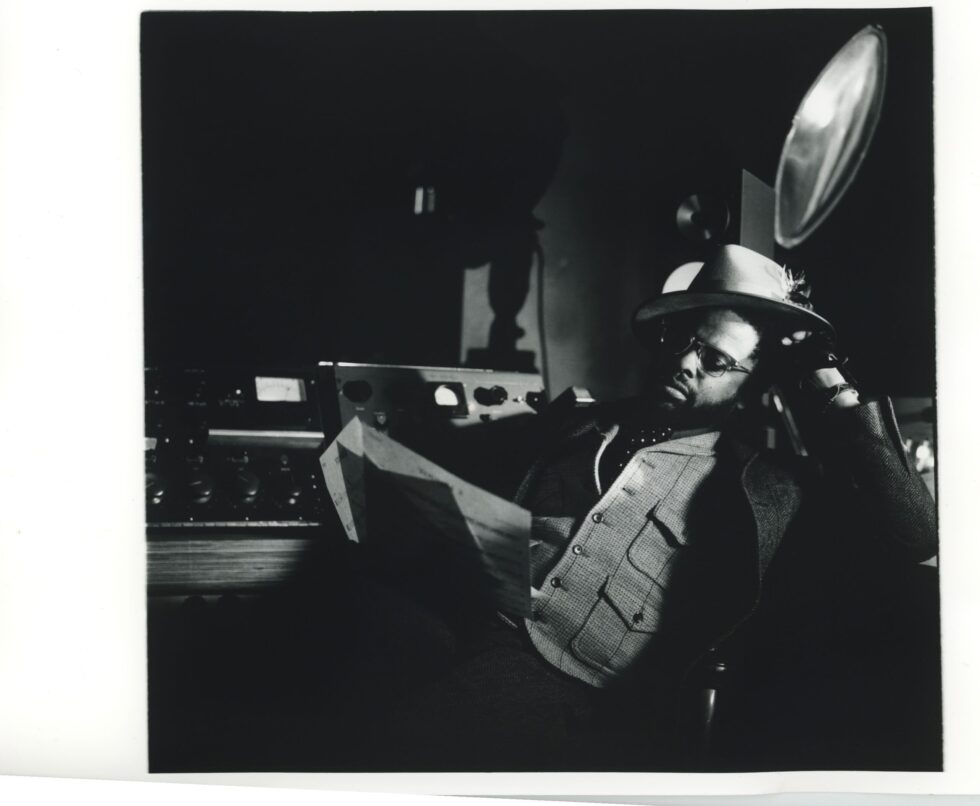
Images Courtesy of Linear Labs
By Annelise Schouten
On July 30th 2026, KZSC’s Jazz and Blues Director sat down with artist, composer, producer, and record label founder Adrian Younge for a phone interview. Speaking on his label Jazz Is Dead, analog studio Linear Labs, recent releases, and current tour with French Jazz band Cortex, Younge describes what production, collaboration, and analog sound means to him.
Composer, producer, DJ, and Emmy winning artist Adrian Younge got his start in music with a MPC 2000 and TASCAM recorder. Born in 1978, Younge began delving into sampling and production at 18, soon teaching himself to play the piano, bass, guitar, and drums, learning more and more about Jazz through listening to his favorite Hip Hop samples. Eventually establishing himself as an esteemed artist in the Hip Hop and Jazz genres, Younge has led an influential career and practice of analog production, collaboration, and artistic direction.
Working with artists like Wu-Tang Clan, Kendrick Lamar, Talib Kweli, Souls of Mischief, Jay-Z, and more, Younge’s production style and vision has defined and transformed contemporary Jazz and Hip Hop. While having produced notable Hip Hop albums like Ghost Face Killah’s Twelve Reasons to Die, and There Is Only Now by Souls of Mischief, Younge’s solo productions have been sampled as well, specifically his 2012 album Something About April, where tracks “Reverie” and “Sirens” were used in Jay-Z’s 2013 album Magna Carta… Holy Grail.
Black Dynamite, a 2009 blaxploitation film, was Younge’s composition and editing debut, giving way to an incredibly successful career in film scoring and the cinematic jazz genre. Alongside partner Ali Shaheed Muhammed, Younge has scored film and TV like Marvel’s Luke Cage, and won an Emmy for his music direction and composition for the Apple TV+ documentary series Home.

In 2017, Younge co-founded Jazz Is Dead, a multimedia platform and label with Ali Shaheed Muhammad, DJ, producer, and member of A Tribe Called Quest. With collaborators including Lonnie Liston Smith, Tony Allen, Roy Ayers, Azymuth, Marcos Valle, Hyldon, and João Donato, Jazz Is Dead has released 27 volumes in the past six years, transcending genre and staying true to their analog ethos. Currently on tour with Cortex through Jazz Is Dead’s concert production company ArtDontSleep, the label thrives on collaboration and the preservation of analog humanity.
Afro Disco Makossa, Younge’s most recent EP and first solo Afrobeat release, draws from past sessions with Afrobeat legends Tony Allen and Ebo Taylor. The six track EP released on July 17th was recorded in Younge’s studio Linear Labs, combining Highlife vocals and horn lines, with classic Afrobeat drumbeats and syncopation. Linear Labs, located in North East Los Angeles, runs on this analog vision. Defined by Adrian Younge’s golden era of music, 1968 through 1973, the studio functions as a fully analog recording space and testament to true meticulous artistry. Through using equipment exclusively from this period, Younge’s sound ‘garners a performance only tape can mandate’.
“I always tell people that if I wasn’t able to record analog, I’d actually just stop making music. That’s how much this sound means to me for what I do.”
Having produced notable records like Younge, Afro Disco Makossa, and JID026 just this past year, Linear Labs is continuing to pioneer analog production in our digital age. With so many Jazz Is Dead, Linear Labs, and ArtDontSleep productions lined up for the near future, Younge’s art and production should be on all music lover’s radars.
This interview has been edited for clarity and concision*
Annelise: Thank you so much for coming on, I’m a huge fan of your work and your production, and also just your ethos and practice of analog recording, I think it’s really important.
Adrian: Thank you very much.
Annelise: And for those who don’t know, if you could introduce yourself.
Adrian: Yo, my name is Adrian Younge, I’m an artist, composer, and I’m one of the co-founders of Jazz Is Dead, which is a record label and events company. And I also own another record label called Linear Labs, and I’m based in Los Angeles California.
Annelise: Sweet, and you just released Afro Disco Makossa.
Adrian: Yes.
Annelise: Which is your first solo Afrobeat album. What was the process of making that album and how did your prior experience and collaboration with Ebo Taylor and Tony Allen inform your artistic direction?
Adrian: Yeah, I’m a DJ and I’ve been DJing for years so I’ve always just loved spinning Afrobeat stuff. And my first foray into Afrobeat is when I did an album with Tony Allen on Jazz Is Dead. Then after that, myself and Ali Shaheed Muhammed did another one with Ebo Taylor. And both of these guys, Ebo and Tony, are no longer here with us but they were Afrobeat greats, legends, pioneers. So I learned a lot just working with them, and during the time I was recording the Ebo Taylor album his drummer Andrew Biny, he’s a Ghanian, and he was here and I was like “man just get in the studio with me, I just wanna record with you”. And literally that turned into the Afro Disco Makossa album. So basically having to do all of the, create all of those albums with Ebo and Tony, and then coupled with my DJing and all that stuff with this kind of music, helped better inform me of the kind of Afrobeat album I wanted to make. And that’s what this is.
Annelise: Yeah I absolutely love the release, I preordered it immediately after hearing the first two singles.
Adrian: Oh thank you.
Annelise: And I got the vinyl in on Monday.
Adrian: Yeaaa, I got to sign it for you the next time I see you then.
Annelise: Yes! I’ll see you at the UC Theater when you come to Berkeley with Cortex.
Adrian: Oh great, bring it, bring it, yes.
Annelise: “Shakedown” is a personal favorite of mine off of it, but as for Linear Labs, if you could speak on what that is and what it’s mission is relating to analog practices and the recording of Afro Disco Makossa?
Adrian: Yeah so Linear Labs is my record label, and it’s also the name of my studio. And my studio is all analog, no computers, and I record music that is akin to my golden era of music which is from about ’68 to ’73, so everything here is recorded with that kind of equipment. It gives me that sound, it garners a performance that I feel only tape can mandate, you know recording on analog tapes. So every single thing I do is recorded to tape, whether it’s Linear Labs, whether it’s Jazz Is Dead, every single thing I do. I always tell people that if I wasn’t able to record analog, I’d actually just stop making music. That’s how much this sound means to me for what I do. So yeah, that’s Linear Labs.
Annelise: And with such a strong ethos surrounding this kind of music production, what experiences throughout your life or your music career have led you to prioritize this preservation of analog humanity?
Adrian: It’s interesting because even though I am quote “preserving”, the goal is not necessarily to preserve. It’s for me to be the artists I’m supposed to be. I always say that an artist should use the best tools possible to create their art, and these are the best tools for me to create what’s in my head. It’s the only way to create what’s in my head. So I’m doing that, but there’s an ancillary benefit where I’m helping to maintain an analog standard for other people to look at or listen to when they are deciding if they want to be analog or digital you know. But for me I just do it because I like it, it’s not much more difficult than that.
Annelise: So I’ll be seeing you on September 18th at the UC Theater in Berkeley.
Adrian: Amazing, looking forward to it.
Annelise: At your show with Cortex, could you tell me a little about your experience working with Cortex and how that relationship came to be?
Adrian: Yeah so Jazz Is Dead, we had a tour with them, I think it was a few years ago or something, their first North American tour and it was absolutely bonkers amazing, it was great. I was DJing on that tour and it was just great. I got to really become close with the Cortex group and now we’re bringing them back to do an even more massive tour. But this time instead of DJing, we have who we call the Funky President, Mr. J Rocc from the Beat Junkies DJing, and I’ll be preforming and opening up for Cortex. So I’m looking forward to that.
Annelise: Amazing, and yeah Cortex is just such an iconic band.
Adrian: Oh yeah.
Annelise: And just being the foundation for so many incredible Hip Hop tracks, with Cortex and a lot of the other collaborations you do, what qualities do you look for in collaborators and artists you’re bringing into Jazz Is Dead?
Adrian: Qualities, just that I like them as people. Secondly that they still have something to musically say. And lastly that we both have the time to do it, that’s it, nothing more deeper than that.
Annelise: And with your other experience collaborating with different artists, and also with score composition too with Luke Cage, and different projects like that. With score composition, how do you think those projects differ from the personal projects and albums that you pursue?
Adrian: I do a lot of film and television, alongside my partner Ali Shaheed Muhammed, and the thing is when we’re doing film and television we have a boss. We have to turn something in and they gotta say if it works or not. But when we’re just doing our music, we don’t have to care about what anyone says. And that’s basically the difference, for scoring we’re trying to actually enhance the visual and also make sure that our bosses and us are on the same page. But with music we just do what we wanna do, so that’s the difference basically.
Annelise: And how did that partnership come to be with Ali Shaheed Muhammed?
Adrian: I was always a fan of Tribe Called Quest and just him individually, and I happened to be in New York around 2013 and he just happened to tweet “Hey Adrian man I love your music”. And I’m like, you like my music? Crazy, I love your music, and we ended up going to lunch that day and have been very very close ever since.
Annelise: Amazing, with your journey with production and music, how did that begin in your early life?
Adrian: I always knew I loved music, I would always like beatbox as a kid and all that stuff, always wanted to make beats and all that. But it didn’t really start until I was around 18 and my parents got me an MPC 2000 and a TASCAM recorder and I just started sampling records and then I was doing that for a year and then I realized that in order to create the music I really loved I had to learn how to play instruments. So I put the sampler away, and just taught myself how to record and play multiple instruments and here I am now you know. So it’s like the best decision I’ve ever made.
Annelise: Oh wow, so completely self taught?
Adrian: Mhmm.
Annelise: That’s amazing. Here at KZSC, going back to what you were saying about analog recording and that way of looking at music and having such a meticulous approach to it, we really value the use of physical media and are trying to push that over digital production in our day to day broadcasting. Using the vinyl and CDs in our library.
Adrian: Great.
Annelise: I was wondering if you have any advice for people who are trying to get into this kind of production or going against the digital.
Adrian: I always say that people should just do what makes them happy. Like recording digital for me would make me extremely unhappy, but that’s just for me and the kind of music I make right? But if you’re listening and you want to make music like the music I make and make it sound that way, you can’t do digital, you have to do analog. Or, if you do digital, it’s going to sound like you’re trying to digitally emulate analog, which I hate, I hate that sound. But maybe you like that sound right? So basically explore, and do what speaks to you. Everybody’s journey is different, nobody’s journey’s better, it’s just what really speaks to you. My journey just happens to be a bit more laborious, and expensive, and vintage haha.
Annelise: And then with all of the music that you’ve been putting out this year with Younge, I absolutely love that album so much, the instrumentals, been listening to it a lot lately.
Adrian: Thank you, thanks so much.
Annelise: With the production of all these albums that you’ve been doing this year, what have you been listening to on your own time during these processes in which you’re making music, or favorite tracks or albums that you’ve been having on repeat?
Adrian: Well, to be honest with you the only time I actually listen to other music is that me and Ali Shaheed Muhammed have a show on KJAZZ, which is a radio station out here that we started a couple months ago. That’s kind of when I’m listening to music, or if I’m DJing, outside of that I really don’t listen to much music because I’m making so much music every day that music is my full time job. So I’m not listening to too much music outside of stuff we’re playing on the station or if I’m DJing to be honest with you.
Annelise: Where do you think your inspiration for music comes from?
Adrian: DJ culture, Hip Hop, you know. I always loved listening to find where the original samples were and then that leads you to finding a new band or new musicians or whatever. But I have a very nice record collection and I love hearing classic music that still holds up today. So my love of old music.
Annelise: Would you say that your start into music was through Hip Hop and it has transitioned into Jazz?
Adrian: Absolutely, like I wanted to be a Hip Hop producer and I realized that the music I was producing by sampling the records weren’t as compelling as the music would be if I just picked up an instrument. So yeah, that’s exactly what that is.
Annelise: What was the first instrument that you learned?
Adrian: Piano, but a lot of these instruments I was learning at the same time. I bought a piano, then soon after an acoustic, then soon after a bass, a guitar, drums, like it was all around the same time, but piano first.
Annelise: And with the future of Jazz Is Dead and Linear Labs, do you have any exciting projects in the works that you are thinking about?
Adrian: Yeah I have an album with Joyce on Jazz Is Dead coming out soon, she’s an incredible Brazilian legendary vocalist. I have an album coming out with a woman named ALA.NI, she’s from London, and that’s coming out in October, it’s like a psychedelic soul jazz kinda album. And then next year I have an album coming out called Astral Lover, which is like my version of a Lonnie Liston Smith meets Roy Ayers meets Parliament- Funkadelic type album. So those are my next big three basically.
Annelise: I’m really excited about hearing that one about Parliament-Funkadelic and Lonnie Liston Smith
Adrian: Make sure you reach out to me when that happens.
Annelise: Oh I’d love to yeah. I think that one of Lonnie Liston Smith ( Jazz Is Dead 17 ) is my favorite.
Adrian: Aw thank you that’s dope.
Annelise: “Fête”, that song.
Adrian: I don’t even remember the song haha, there’s been so much music I just appreciate anybody that pays attention like yourself it means a lot thank you.
Annelise: Thank you! Yeah we have a pretty stacked collection of Jazz Is Dead here in the station and we play it pretty frequently, I know I play it on my shows.
Adrian: Thank you.
Annelise: What’s that collaboration going to look like with the Lonnie Liston Smith, it’s inspired by those artists? Or is there?
Adrian: Yeah it’s me with vocalists and my band, and I just wrote a lot of music that feels like Roy Ayers, that feels like Lonnie Liston Smith, that feels very Parliament-Funkadelic at the same time. It’s just a combination of all that you know. So if you could imagine it, when you hear it you’ll remember we had this conversation and then we’ll talk, you know.
Annelise: Great! And growing up what music were you listening to, were you listening to these soul and funk artists?
Adrian: Soul, Funk, Hip Hop, Psychedelic music, Prog Rock, everything. Everything that Hip Hop would sample basically. All of that.
Annelise: I feel like I find myself finding a lot of my favorite Jazz tracks through Hip Hop, like “Ooo I really like this sample” and then going down the rabbit hole, because everything connects with that. I think Lonnie Liston Smith was a big catalyst for that, and finding Expansions and those tracks.
But what has your experience been touring with Cortex so far, what are you looking forward to in the tour, different venues or spaces or audiences that you’re excited about?
Adrian: Well when I was with them a few years ago it was fun just to see people reacting to seeing Cortex for the first time, but now it’s gonna be even more fun because again I’ll be playing, not just DJing. So I get to express myself alongside these legends and looking for ward to it, looking forward to Mexico City, New York, LA of course, Chicago, Vancouver, we’re gonna be in Berkeley. So many places I’m just looking forward to the whole thing, it’s gonna be absolutely fun.
Annelise: I’m so excited to see it. It’s such an honor to be speaking with you seriously, I am just a huge fan, I think a lot of the ways that I look at music is if I find a release I really like I’ll go into what label started it, and I feel like everything comes back to Jazz Is Dead and Linear Labs for me.
Adrian: That is so dope man.
Annelise: Thank you so much.
Adrian: Thank you.