
Written by Claudia Aguilera
On the first night of tour, and the eve of their debut album’s 19-year anniversary, LSD and the Search for God reflect on how a nearly-missed beginning became a lasting body of work. Since the release of their self-titled debut, the band has occupied an enduring place in modern shoegaze, creating music that listeners tend to step into rather than decode.
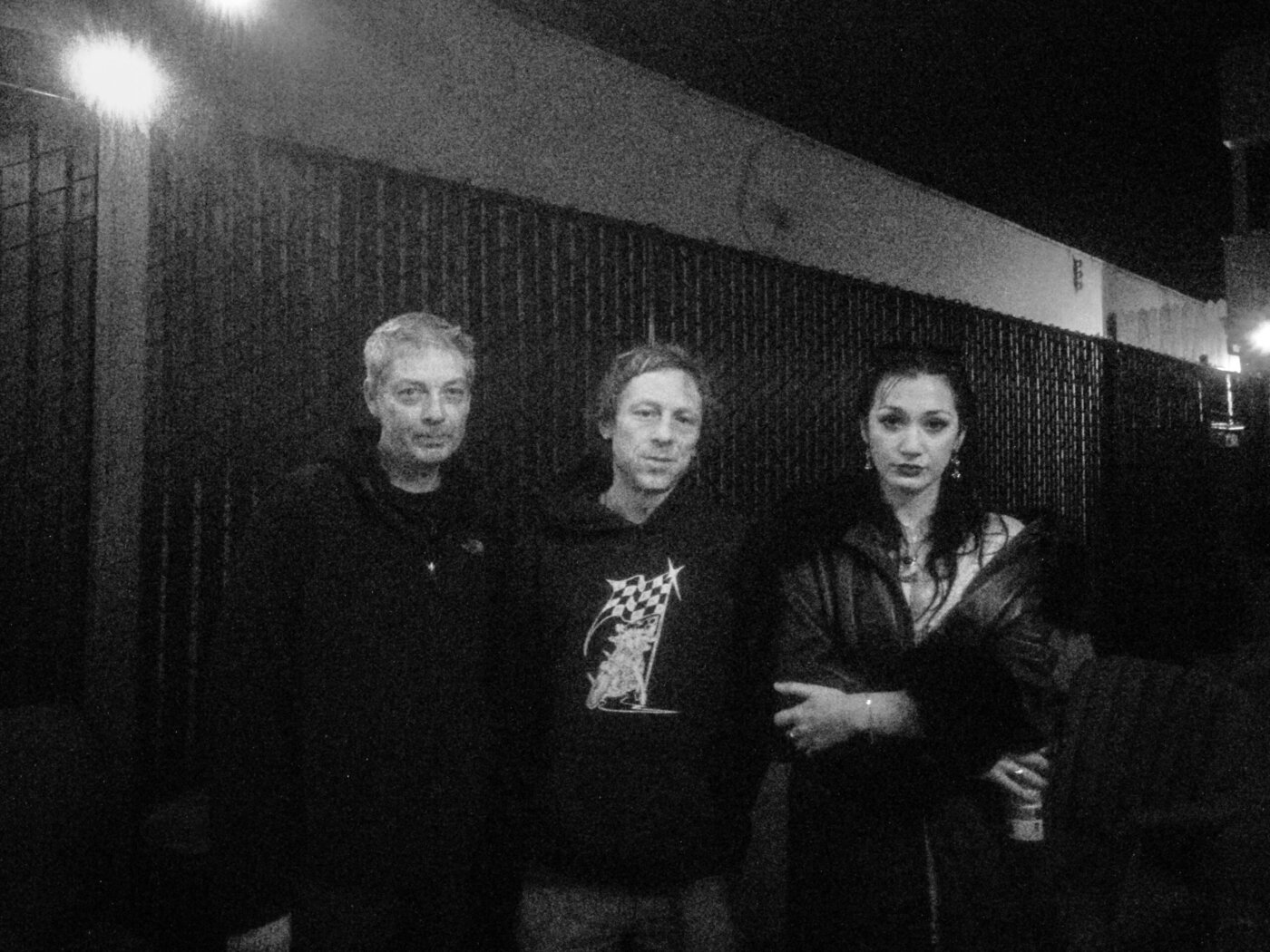
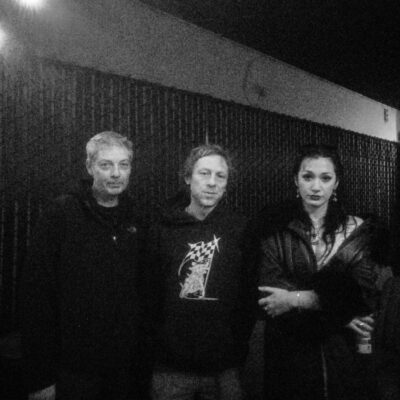
Backstage at the Catalyst, with 60 Juno sound checking on stage, I sat down with Chris Fifield (guitar), Andy Liszt (vocals and guitar), and E. Scarlett Levinson (vocals) on the opening night of their January 2026 tour. Upon asking about the beginning of tour, the band shared that without their tour manager (scheduled to join later) they’d had to unload their own gear — crediting Scarlett for handling the heavy lifting — and that their lighting person had broken his ankle the night before. Yet even amid the unexpected, the mood was light and lively. In this interview, the band discusses creative process, community, and the idea that art is never finished.
First Impressions
Claudia: My first question: For people discovering you for the first time, how would you describe LSD and the Search for God?
Andy: I wouldn’t.
Scarlett: I knew you were going to say that. I f*ing knew it.
Andy: I mean if I made someone a meal, I wouldn’t want to just describe it.
Chris: Sounds and melodies.
Band Origins
Claudia: When this project first came together, what kind of headspace were you in, and how much of that still carries through today?
Chris: I think it all carries through to today.
Just, you know, being a conscious being, trying to make good music and sounds.
Andy: Chris and I met through a Craigslist ad. She had us call each other before we all met up.
Chris: I wasn’t wanting to start a band from scratch — that was the last thing I wanted to do. I was tired of playing with friends and having a project fizzle out. She kind of tricked us into doing what I didn’t want to do. It’s kind of crazy to think about; I almost didn’t call him. I was this close to not calling. Socially awkward, you know.
Andy: After two or three practices, I remember calling Chris and telling him my loyalty was to him, not this project. “If you want to bail, let’s do it.”
Chris: Yeah, it almost didn’t happen […] but that started this whole thing. I’ve got to have appreciation for that.
Music as a Shared Experience
Claudia: A lot of listeners experience your music as something they project into. Is that sense of projecting and receiving something you’re consciously aware of, especially playing live or while recording?
Andy: It feels very communal, in all kinds of ways. We feel a connection to a lot of our fans. It’s a really neat thing. We’re lucky to have the people that we meet every night — that we play for, talk to, and hear from. They’re lovely.
It’s interesting and fun talking to college students about that. I identify with it — at 15, 16, 14, 35 years old, I was that person as well. Music… texts about “This saved my life”,
I identify with all that because music has been that vehicle in my life all the way through. It’s that need to be involved in that cycle, paying it back in a lot of ways.
There’s been plenty of music that has changed my world, for the better. Or been there for me when I needed something to be there for. I have a feeling that people who are drawn to this, have an understanding that it really is reciprocal. We absolutely feel that and can identify with it.
Chris: Yeah, that’s well put. I don’t know the full extent, but I feel it and appreciate it. Its special, you know. Not every band gets to have that. We do appreciate it and its quite meaningful to us.
Songwriting and Creation
Claudia: Going into a little bit of your writing process, not to say that you’ve been maybe in the studio…
The band chuckles.
Claudia: But in the past, when you write…
The band breaks into laughter.
Andy: You’re good.
Scarlett: You’re good. Clever.
Andy: We’ve got good cop and bad cop. You’re clearly the good cop — buttering us up.
Claudia: When you’re writing, do songs start as a mood, as a riff, or maybe something more conceptual?
Andy: It’s really different, depending on the song. Being open and receptive, being tuned into the frequencies of the day.
Sometimes it feels very much like a conduit and being able to be in the right place to receive.
Sometimes it’s interesting, we’ll sit down, and all the sudden, there’s the whole song. Sometimes lyrics live in my head for a long time, and I know its going to be something at some point, I’m excited about a part of it. I might bring it into the studio or goofing around with it with Chris, and suddenly I hear something I never would have thought would work, and it sounds 100x better and it steers the arrangement.
Claudia: Kind of along those lines, how do you know when a song is finished being written?
Andy: Well, Scarlett the other day said — talking about songs — the idea that all art is abandoned art.
Scarlett: It’s never finished, it’s just abandoned.
Andy: I was really held back when I was younger, throttling myself into thinking a song had to be “done.” I was at a museum in New York, at the same time I listening to something — maybe Bob Dylan, maybe I’d been to a Spiritualized show where they had done some Spacemen songs. Same songs, but the arrangement was different — and I had what felt like an epiphany.
One thing that’s so neat about a song, it really can be a living, breathing body of work. A good song is a good song.
And whatever headspace you’re in that moment, and however you want to put and arrange it, can be done unlike a visual artist. We have that as well. We can put it in a “frame”, put a timestamp on it, but at the same time it can also be a living, breathing body of work that moves with you. It was really liberating.
Chris: Quite eloquently put. I feel similarly, it’s never really done. I can always improve something. I’m going to wish we can record in two years, because then I’ll have my parts better, that kind of thing. That makes live performance exciting, a song can be different each night. I think about the Grateful Dead, tons of respect for that band — they were never done.
Claudia: Rest in peace, Bobby Weir!
Chris: I know, I know, I know. Exactly, I’ve been thinking about them, very close to my heart. It’s a great model to follow. Plus, they had the communal relationship with their fans. They’re the ultimate as far as that goes.
Claudia: Would you consider yourself a Deadhead?
Chris: I mean, yeah I went to Dead shows as a kid. Part of me… I don’t know. I never called myself that. But I grew up with it; it’s my dad’s favorite band.
Andy: Scarlett’s father saw them 200 times before ’69?
Scarlett: That’s correct. My name may or may not have something to do with a Grateful Dead song. What I was going to say is, the idea that you can do something better in two years, you’re totally right.
But if you don’t record the thing now, you won’t get to that place in two years where you’ve improved. So, you have to do it now.
I listen to things I did five years ago and think, “Damn, I could do it so much better now.” But that’s the whole point, I got better with time.
Chris: When I hear old things, even from other projects…
You’ve got to respect your younger self, too.
Scarlett: Yeah, just trying their best.
Andy: I have a friend who’s an author and has written five or six nonfiction books. He says if you want to learn something about something, write a book and see what comes back. His point is that: You think you’re an expert, you do all this research, and suddenly you start hearing from people who know a little something more.
Scarlett: It’s the coolest thing you can do — go outside and ask people.
Andy: The only problem is, you have to listen. A lot of people aren’t so into that. Oh, but it’s easy for me! I love listening to stuff.
Chris: I forget who said it, but I recently heard that one of the secrets to life is staying curious.
Andy: Hell yeah.
Claudia: I always try to remind myself that life is a continuous learning process. I’m always going to be a beginner.
Scarlett: Oh my god, I love being a beginner! The learning curve is so exciting — you start something new, you learn it, then you drop off and plateau for a bit, and it gets challenging until you start having ups again.
Music Discovery: Then and Now
Claudia: When your record first came out in 2007, shoegaze felt like something you found rather than something that’s algorithmically surfaced. Do you think that sense of discovery still exists today or has it fundamentally changed?
Andy: I think it’s fundamentally changed. That’s just a neutral thing, perhaps. I’m nostalgic for the way you used to have to do it — really work hard at it. Record labels were more important then, there were different gatekeepers. You had to search for things that are different and weren’t being driven and given to you. Everything’s at your fingertips now, but it’s easier to go down a rabbit hole. It’s quite different, but that’s just the reality.
Chris: In a lot of ways, it’s easier. Sometimes I don’t envy your generation — everything is available, but there’s more to sift through. I remember buying a CD as a kid, if I didn’t like it immediately, I didn’t have much money so I was kinda stuck with it. I would give it more of a chance.
We have a jukebox at our fingertips, but that’s great because so many younger people have found this amazing music that I had no chance at discovering when I was 15 and just sifting through records. So, tradeoffs. But I think in both cases, you need curation, however that is. For people our age, a lot of times it was an older brother or sister that had cool records.
Andy: Girlfriend’s older brother. In my situation, I didn’t have an older brother.
Chris: Young people now have to sift through a bunch of dribble online to find the same cool bands we found through more human processes. I generally feel that everything stays the same, just different iterations.
Scarlett: I like the concept of being neutral.
Touring and the Local Music Scene
Claudia: You’re opening this tour in Santa Cruz…
Andy: Hell yeah. At a place we hope sticks around, but we know…
Claudia: Save the Catalyst!
Andy: Yeah, no kidding.
Claudia: …which in my own experience has a really alive, community-driven DIY scene, that includes shoegaze. As someone who cares about the local music ecosystem, I’m curious how smaller scenes and physical venues factor into how you think about music being kept alive or rediscovered.
Andy: That’s a really interesting question. I feel the same way you do, about local music and local art. We love playing at independent venues and supporting them whenever we can.
A place like The Catalyst — the [Atrium] is different and intimate — but even a 1000 cap, there’s an intimate feeling and an intimate spirit and it comes across and I think that yeah, we pay attention to that.
We try hard to play all-ages shows and independent venues. Neither always works out but it’s important to us.
Chris: There was a house venue called “The Basement”… that’s not around anymore?
Claudia: Not to my knowledge, but there are still a lot of house shows in Santa Cruz. One issue they’ve run into is that the cops sometimes fine them for the noise.
Chris: I recognize and appreciate the long tradition of Santa Cruz DIY underground music.
Claudia: I’d say the Santa Cruz DIY staple is SubRosa, which is an anarchist library.
Scarlett: Yeah! I love SubRosa, I f*ing love it there.
Claudia: It’s very teeny tiny — smaller than a house.
Chris: Much respect for you guys doing that.
Scarlett: It’s fun to do spaces like that.
That’s where everything starts.
We had a place like [SubRosa], it wasn’t an anarchist library, but it was a small spot where everyone played. It was called Honey Hive Collective, but it closed because of the pandemic. Just this tiny little room in the Sunset [District] in San Francisco. Bottom of the Hill is one of the best venues, and they’re closing down.
Recent Inspirations
Claudia: My last question: Is there anything you’re listening to right now that’s been inspiring you?
Andy: At the moment…
Scarlett: Nothing at the moment? That’s not true…
Andy: Scarlett and I saw some ’90s bands on New Year’s Eve at the Fillmore — Luna, Yo La Tengo. It was fun to see bands that had a hold on me at a pivotal age. Three of my favorite guitar players were there.
Chris: I don’t have anything right now.
Andy: Scarlett’s been listening to a lot of my music.
Scarlett: More likely, I’d say Future Perfect by Autolux. It’s something I always listen to at the beginning of a tour, or on a plane, it’s one of the only albums I have downloaded. I’ve also been listening to Emma Ruth Rundle’s Marked for Death.
Andy: Lomelda! You heard of Lomelda? Write that down!
Scarlett: Lomelda is one of my favorite artists. I can’t listen to her too often because I know everything too well — if I’m playing Lomelda, that’s how you know I’m blacked out drunk. She’s amazing. I saw her at the Great American Music Hall; it was just her and a bassist. She came out with all these new things, so I know she must be working on a record. Hannah, if you’re hearing this — we’re waiting on you!
Nearly two decades later, LSD and the Search for God remain less interested in defining their work than sustaining the conversation around it: between bandmates, between scenes, and between listeners who find something of themselves in the sound. In that sense, their music continues not as a finished statement, but as a shared space, shaped by whoever steps inside.
You can stream LSD and the Search for God on Spotify, Apple Music, Bandcamp, YouTube, Soundcloud, and Tidal.
Thank you to the band for sitting down and chatting with me!